The Contemporary Vindication of R.M. Nixon
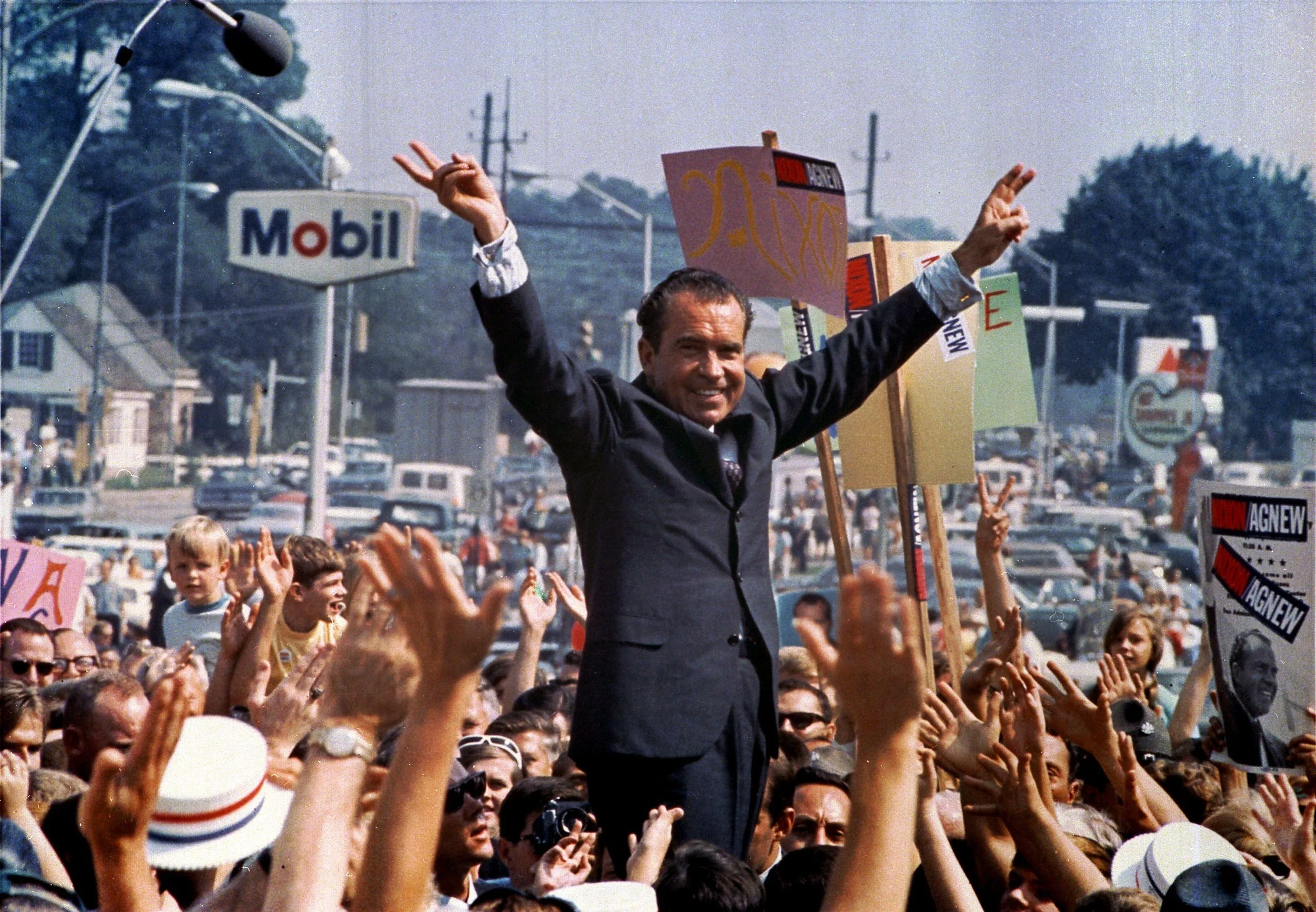
Richard Nixon on the campaign trail in 1972 - via Alamy
Lately, there has been a great deal of discussion within certain circles of thought in our country, about the political legacy, and associated scandals, of the Presidency of Richard Nixon. The Nixon Presidential Library has undergone costly renovations in recent years, and the Nixon Foundation has had a renewed presence in the form of articles, YouTube videos, and many widely circulated clips on social media. In addition to this, there has been a slew of Watergate related information released from the National Archives in recent years which has shown to alter the traditionally believed narrative on the scandal, the cover up, and the subsequent prosecution and impeachment hearings.
There is a mountain of content and information online about such files related to Watergate, some of which will be linked with this article for further viewing, but it is much too dense a topic to discuss in the contents of this piece.
Rather, we should like to focus on Nixon’s image today.
Although it is up for discussion, Americans know what happened at Watergate. They know corruption unfolded at multiple levels of the administration and within the Committee to Re-Elect the President, the DOJ, the FBI and the CIA as well. Less known may be that which occurred on the side of the prosecution, including at least seven backdoor meetings held between Judge John Sirica and the lead prosecutors of the Grand Jury. But again, these topics are for another day. Following the failed, and inarguably political Federal, State, and County prosecutions of President Donald Trump during the 2024 election cycle, the stigma around the scandal, and the once rhetorically lethal line many times uttered by former Nixon White House Counsel and star witness John Dean, “worse than Watergate,” a line he even used to title a book, began to lose whatever credibility it had retained by that time.
Startling it is, that the rehabilitation of Richard Nixon’s image in the public mind has mostly come not from newly revealed information, little of which is widely known, but from real events that unfolded in the public eye over recent years. The often skewed views of university academics and political pundits aside, much of what we know the Nixon Administration to have been involved in, would be difficult to describe as astoundingly “worse” than acts of corruption which took place in this decade, or the previous one for that matter. Or even those of members of the Democratic Party between 1961 and 1974. And, in that regard, the more positive aspects of his presidency have been allowed to shine, and be reopened for popular examination.
Richard Nixon was a formidable poker player, who spent much of his younger years at the cards table. It was from this experience that many, including himself, have pointed to as the basis for his bulldog negotiation style with other foreign leaders. In the course of less than 6 years in office, Nixon opened relations with China, who had been entirely cut off for nearly 25 years from the West, was able to initiate SALT I (Strategic Arms Limitations Talks 1), and sign the Anti-Ballistic Missile Treaty and the Interim Agreement on Strategic Offensive Arms with the Soviet Union under General Secretary Leonid Brezhnev. Both of which were milestones in strategic arms control, taming the temperature of the Cold War by an order of magnitude. Moreover, Nixon fundamentally rewrote standard American strategic thinking regarding the Cold War at the time. He axed the 1950’s policy of Containment, shifting to his own policy ideas of Détente, and legitimizing the view that we do exist in a multipolar geopolitical environment. As well as, in Kissinger’s advisory, implementing the Machiavellian ideas of Realpolitik in dealing with our global adversaries. In reassessing our relationship with the Soviet Union and China, he was able to pull concessions from both powers which would have been unthinkable under Eisenhower, Kennedy, or Johnson.
Nixon’s handling of the Vietnam war has been, in the opinion of this publication, widely smeared as a war crime ridden assault on all that is human. This we view to be mostly incorrect, although strategic miscalculations were undoubtedly made, horrific acts were perpetrated on a limited scale by American (and less limited, by Viet Cong) soldiers, and the US withdrawal cannot be reasonably concluded to have been anything but a saving of face for the United States. The beginning of American involvement in the Vietnam War began in 1961, with the deployment of special operators into the region, but did not seriously pick up until 1965. Given the activities and political motivations of the North Vietnamese militants in starting the war, it fits perfectly in line with the existing policy at the time of Containment, that American military involvement was justified, and necessary. This we are not here to debate the ethical validity of, but would like to point out that it was not merely the actions of a rogue Johnson Administration which involved us in the debacle. Many before him share comparable blame in the policies which led up to the conflict, something Nixon shares little guilt in.
An argument can be made that Nixon leveraged the Vietnam War, and ramped up bombing on the country, as a means of signaling to Soviet and Chinese leaders that he meant business. Similar in ways to the current American military action beginning to unfold against Venezuela. This too we are in partial agreement on, but fails to give an explanation for the bombing of and incursions into Cambodia, which had clear military significance to the VC, and additionally posed a clear and ever present threat to American soldiers and resources within Vietnam, though its impact on the rise of the Khmer Rouge is certainly debatable. Regardless, it fits within the purview of Nixon’s approach to major power relations, that it was necessary to make known that a war could not be won outright against the United States, of which forceful proxy wars are a great means of conveying that message through. More difficult it is however, for average Americans to fathom the justification for sending our boys to die as a negotiating tactic against a militarily uninvolved country. Many comments on Nixon’s actions in Vietnam fail to consider the alternative, what a second Johnson administration, or one of Hubert Humphrey’s responsibility, which could likely have led to a chaotic and clumsy withdrawal, if not extended entanglement which continued past 1974. In war, where there is almost never a good choice to be made, it is often the case that swift and forceful action is in the long term, less destructive to human life than protracted, lower intensity engagements which prolong population displacement, and the general dangers to civilians, be that in the form of direct collateral violence, or the many humanitarian crises inevitably spurred by large scale conflict.
Nixon had a domestic record which was marked by precise and prudent regulations, including the establishment of the Environmental Protection Agency, which at the time, was much needed in the face of wanton industrial abuses of the environment by American companies not just on US soil, but globally. Nixon also removed the United States from the Gold Standard, something libertarians and center-right monetary policy hawks have oft gawked at. Another dense topic indeed not warranted for detailed discussion at this time, but in short, necessary to end an unsustainable practice given the meteoric growth of the US economy, and constraints on the money supply in the two decades prior. He also established NOAA, OSHA, and amended the 1967 Clean Air Act prompting reductions in automobile emissions as well as national air quality testing. Other notable environmental legislation signed during Nixon's time in office included the 1972 Noise Control Act, the 1972 Marine Mammal Protection Act, the 1973 Endangered Species Act, and the 1974 Safe Drinking Water Act.
Above all else, Richard Nixon was an eloquent and well spoken man, another quality which has been needlessly smeared as untrue by his detractors, as early as the 1960 election. In reviewing his post presidential interviews, his views on foreign policy can be seen to be nuanced and deeply thought through. No American President since has come off as being so pragmatic on such matters. He spoke in a stern, and direct manner, rarely embellished with catch phrases and rhetorical flourishes apparent in many other career politicians. Many have described him as a paranoid and tortured, but savant like genius, something we find to be corroborated in his foreign policy prodigy. The story of Richard Milhouse Nixon was that of an American great, who in his own words, “came up from the bottom,” worked his way through school, fought in World War II carrying the insignia of the United States Navy, personally funded his first house campaign with $10,000 won in a poker game, and became Vice President just six years later. Defeated by Kennedy in 1960, he staged perhaps America’s greatest political comeback in securing his seat in the White House 8 years later. He won re-election in 1972 by the largest popular vote margin in American history. As a man, he possessed the traits of a rugged fighter, one who would doggishly keep going through the mud in the face of all opposition. Not even Watergate could keep him down, and in his later post presidential years, he was frequently consulted by sitting US Presidents for foreign policy advisory, becoming the true elder statesman of his own time.
How deprived we are of such men today, we may never come to realize before it grows too late.