Steve McQueen: All American Badass
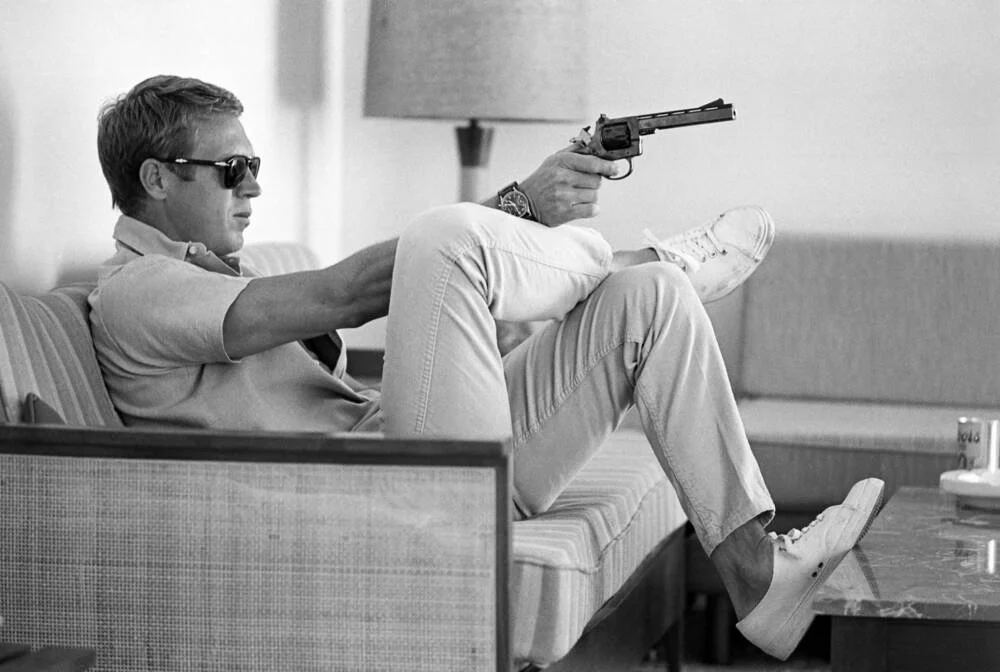
Beer drinker, pot smoker, hell raiser, racing driver, filmmaker, and primal example of the American Dream. “Basically… I come from the gutter” McQueen said in conversation with Charles Champlin in 1978 at Loyola Marymount University. He was speaking on one of his final films, An Enemy of the People, the commercially disastrous screen adaptation of Henrik Ibsen’s play by the same name. A now forgotten picture he was executive producer of, which radically departed from his previous roles as a shoot em up Western character turned highest paid actor in Hollywood and star of The Great Escape, Bullitt, The Magnificent Seven, The Thomas Crown Affair, Le Mans, etc… It was a film made purely “for myself” as he put it, much like Le Mans, his seminal project on endurance motorcar racing at the 24 Hours of Le Mans. McQueen’s life would end less than 2 years later in Mexico when he had a heart attack as a complication of surgery to remove mesothelioma tumors from his throat, aged only 50.
In 1974, Steve McQueen quit acting for a period of 4 years to devote his time to motorcycle racing, traveling cross country on bikes and in a motorhome, which he had considered doing since as early as 1966. The second you get famous, “you stop your personal growth”, he said, and after the completion of The Towering Inferno, he disappeared completely from the public eye, grew long hair and a scruffy beard, and went on the road. It was in that time that he seemed to find a new man in himself, “there’s a lot out there, I’m livin’ now” he said in 1978, after giving up racing and the fanatical obsession with speed that had defined him until then. He was ready to move away from acting to exclusively produce films, something he had become steadily more interested and involved in since starting Solar Productions in the late 60s. That his life, and creative output were cut so short, is a tragedy of immeasurable proportion.
McQueen was born in Indiana in 1930. His father was an air circus pilot who abandoned him and his mother when he was six months old, and with the Great Depression intensifying, his mother left him to her parents when he was 3. He then spent 5 years on their farm in Slater, where he said he developed an interest in racing cars from a red tricycle his grandfather gifted him for his fourth birthday. At age 8, he was taken by his recently remarried mother to live with her in Indianapolis, where his new step father beat him severely, and frequently. At 9 he ran away to live on the streets.
It wasn’t until McQueen was 14 that he was reunited with his mother, who had since moved to Los Angeles, and married yet again. His second step father beat both he, and his mother, which prompted him to leave home for the farm one more time before eventually returning home and resuming his activities as a petty thief and gangster. He was caught stealing hubcaps and arrested, which resulted in him being committed to the California Junior Boys Republic, a reform school in Chino Hills, California. It was there that McQueen finally started to develop some discipline in life, although he remained an outcast within the group for some time.
After leaving the Boys Republic at 16, he moved in with his mother in Greenwich Village, where he ended up signing onto a Merchant Marine ship bound for the Dominican Republic, which he quickly abandoned upon arrival, and found himself in the employ of a brothel. He then found his way to Texas and worked transient jobs for a while, including one as a lumberjack in Canada, even landing himself a 30 day assignment on a chain gang in the South after a vagrancy arrest. At 18 he enlisted in the Marine Corps and “was busted back down to private about seven times”, but ultimately received an honorable discharge in 1950 after having saved the lives of 5 other marines during an arctic training exercise, pulling them from a sinking tank before it slipped through the ice.
It was then in 1952 that McQueen began studying acting in the conservatories of Sanford Meisner and Uta Hagen, with the help of the G.I. Bill. Around the same time, he began racing motorcycles on Long Island Sound, purchased a Harley Davidson and a Triumph, and quickly became an acclaimed rider, regularly earning an inflation adjusted $1,250 a weekend. He was known to be something of a roughed up loner, riding his bike in no particular direction in the deep of the night for hours at a time to escape the world.
In 1955, he debuted on Broadway, in the same year that he moved back to Los Angeles to pursue acting in Hollywood. In less than a year he had obtained supporting roles in a series of B-movies, which continued until 1958 when he was featured in an episode of the NBC Western series Tales of Wells Fargo. Shortly after he played Randall in the pilot of Wanted: Dead or Alive, which would prove to be a major career break for him, the show ran for 94 episodes until 1961. He had the luck of replacing Sammy Davis Jr. in Never So Few, starring Frank Sinatra, and his movie career ascended from that point onwards. John Sturges cast him in The Magnificent Seven shortly after, in 1960, where he played the billed role of Vin Tanner.
Famously, McQueen enraged lead actor Yul Brynner, for his many distractive and performative gestures in the background of Brynner’s appearances, leading him to accuse McQueen of stealing his scenes. Brynner refused to draw his gun in the same frame, knowing he would be outdrawn. McQueen then played the leading role in The Great Escape in 1963, cementing his status as a top dollar movie star across the US. His motorcycle riding in the film is now legendary, although the picture defining bike jump was performed by racer and stunt rider Bud Ekins, who went on to double, and drive for McQueen in movies for years afterwards. The two also raced together frequently, even entering a US team into the International Six Days Trial, an enduro motorcycle race event held in East Germany, which they both shruggingly failed to finish in.
He starred in a slew of other films throughout the 60s, most notably Bullitt, his own favorite, where he played San Francisco cop Frank Bullitt. The film features some of American Cinema’s quintessential on screen driving, with his legendary dark green 1968 Mustang GT 390 fastback. Which, despite great efforts, McQueen was unable to purchase following the film’s completion. Again, Bud Ekins, along with Loren Janes performed much of the stunt driving, although McQueen also drove in closeups.
With newfound success, McQueen became ever more interested in racing, on several occasions considering a professional racing career. He finished third in the 1961 British Touring Car Championship at Brands Hatch, driving a BMC Mini Cooper. In 1970, he and Peter Revson came in second place by a margin of 2.1 seconds in the 12 Hours of Sebring, driving a Porsche 908/02, an event which maddened McQueen and only served to strengthen his desire to race seriously. When the production of Le Mans was finally nearing, he was insistent on driving in the race itself that summer of 1970, but at the threat of compromising the film’s funding, capitulated. He would spend the remainder of the summer and part of the following fall driving in excess of 240 mph on a near daily basis, along with much of the race’s lineup of drivers, for the filming of Le Mans; the most overshot film of all time, noted to have exposed over 25 miles of 35mm stock.
Le Mans was something of a personal disaster for McQueen. Following a likely drunken crash of a Porsche 911 in the woods one night, with a 20 something girl in the passenger seat, his first wife Neile Adams left for the States and took with her their two children Terry and Chad, later to divorce him. At the time he was alleged to have been sleeping with on average 12 women a week. McQueen was hyper controlling of the film, which went through over 60 scripts during production, after Alan Trustman, writer of Bullitt and a close friend of McQueen’s was fired and his original script was abandoned. Trustman never wrote for the screen again. Director John Sturges also left as the film was going massively over budget with little to show for it. Lee H. Katzin, a little known TV director was brought in to fill his role, and could be said to have been a puppet for McQueen to quasi-direct the film through.
More, Le Mans went so badly overschedule, that by the end of principal photography, they were spray painting the leaves of trees around the track to conceal the change of seasons. Katzin wanted to shoot an alternate ending for the movie, where the Ferrari 512 driven by Erich Stahler overtakes in the closing minutes of the race to win. While filming the overtaking maneuver, racing legend David Piper crashed a Porsche 917, leading to the amputation of his right leg.
McQueen owned over 100 motorcycles and 100 cars at the height of his career, including a number of the cars used in Le Mans. The Gulf liveried Porsche 917 he drove in the film recently sold at auction for $25 million. He also had a collection of airplanes and a hangar at Santa Paula Airport. He smoked cigarettes continuously, was stoned “constantly,” and reportedly never left the house without a cooler full of cold beer. In the early 70s, he had a hefty coke habit. Despite his meteoric accumulation of wealth, his taste outside of cars was unpretentious and remained largely unchanged. He almost only drank cheap American beer, and was not one to dwell on the minute qualities of the finer things in life. He drove around Hollywood like it was a circuit, often being pulled over and let off by cops after they discovered his identity. He carried a handgun at all times in public after the Manson Murders, of which he was revealed to be a target. He slept with numerous women, and had affairs with a handful of gorgeous starlets of the time. His antics went so far in fact, that upon having a falling out with his neighbor and friend James Garner for his participation in Grand Prix, a film McQueen hated with vehement passion, he began urinating on Garner’s beloved flowerbed nightly.
That is, of course, the Steve McQueen we all remember. The man in the spotlight, who seemingly could care less about anyone’s opinion of him. “I live for myself, and answer to nobody” he said, a machismo which he carried with him unto his death. But it was the dishevelled, unkempt man disappeared for the road, abdicating the throne of the King of Cool, who is perhaps far more interesting. To hear him speak of that time, he revealed the young boy within him, who was never truly able to develop in youth. He presents a portrait of an emptiness filled by inebriation, fanaticism, hardcore thrill seeking, and a perennial desire to live on the edge of survival. Not until his time away from the camera, did he seem to find any kind of stability in his life, which even then was far from that of any ordinary person.
In time passing, many have accused his performances of being bland, limited in scope, one dimensional, and even lazy to quote one heretical Redditor. This I find to be a misinterpretation of a different era of acting, of which McQueen was an inarguable departure. However, it is mostly true that he fit within a small envelope of roles, of which he capitalized maximally. His physical presence on screen, and distaste for unnecessary dialogue, are hallmarks of why his films have aged so well. The broodyness, the cocky smirk, and the lonesome mystery of his characters leave as much intrigue as they do some kind of dirty, ragged charm. And no doubt, the legend of his life off screen did much part in holding his place in the public conscious, and elevating that audience intrigue. He was among the last of a breed of star actors before the dawn of celebrity worship as a cultural facet of the United States; with the scars of his rolling stone upbringing, and his hard lived habits, giving to cinema what texture gives to a painting.
There are some men in this world, whose burning ambitions, and desires, can be seen clearly in their eyes. Always with a crazed, unflinching look of intense focus. Among many men who did daring things in the past, they shared that same look, and with it, the ambition, resolve, and near delusional confidence needed to spit in the face of rejection and failure, and keep trudging toward their chosen goals. We once venerated, and widely emulated this rare breed of exceptional men, but today it seems they are all but forgotten about, whatever appeal once held around them branded by the Jacobins as toxicity. This is without doubt the collapse of a pillar of the Western ideal. If we as a culture are forbidden to celebrate those most accomplished and foundational figures of our great project ー those who have forged the standards not only of art and media, but all aspects of our institutions ー we are to have lost foundation itself.