Putin’s Gamble
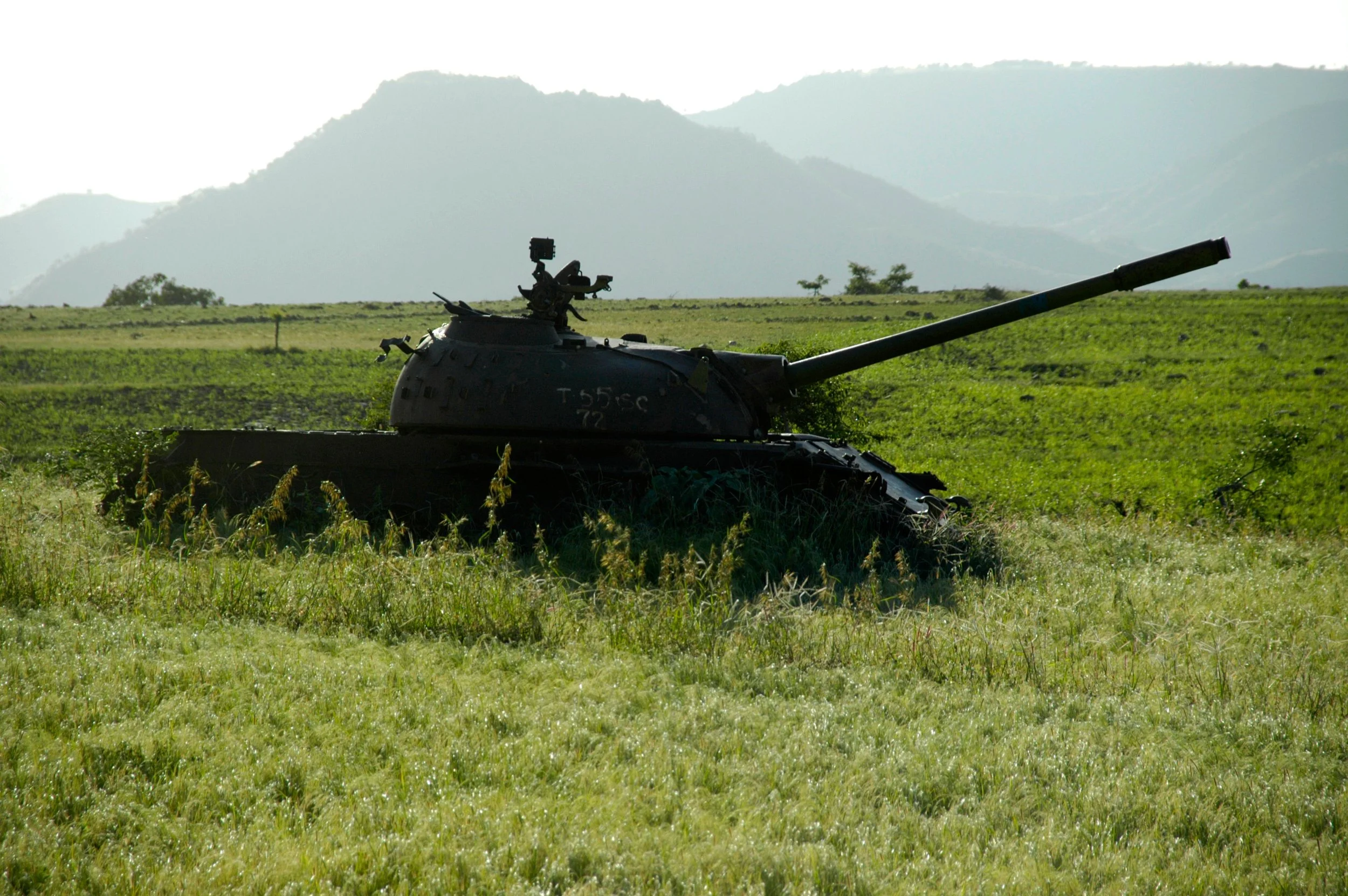
An abandoned Soviet tank near Aksum, Ethiopia
Stefan Auth - Alamy
In June of 2025, the Russian para-military organization the Wagner Group exited Mali, declaring its security operations in the country to be “mission accomplished.” It should however be noted, that the Russian Defense Ministry operated Africa Corps, established in 2023, has remained in Mali, and hired back some 80% of former Wagner forces deployed to the nation. Starting in 2017, Wagner began operating in Africa on behalf of the regime, establishing transactional security relationships starting with the governments of Sudan, and later the Central African Republic, Madagascar, Libya, briefly Mozambique, and finally Mali, entering in 2021. The purpose of these engagements was, on paper, to provide training, arms sales — Russia, and formerly the Soviet Union, has been a major arms supplier to the continent for generations — and support for sovereign militaries in quelling instability, terrorism, and antigovernmental para-military activities taking place in the respective areas. Specifically targeting weak regimes with a desire to hold on to power but lacking effectiveness in doing so, with a dangerous presence of armed opposition groups. But this has always been a business arrangement, services provided for, and funded by, local governments in exchange for access to valuable natural resources, rare earth minerals, gold and diamond mines, as well as expanded access for Russian military usage of airbases and ports, among other kickbacks. Given the weak local security environment and ‘show of strength’ image desired by many African leaders, it is unsurprising that the proposed capabilities offered by Russia would be an easy choice to sign on to.
Less recently, the Soviet Union had a sizable presence in Africa, having allied with Marxist and generally anti-colonial governments that appeared in the power vacuum of the widespread European withdrawal from the continent following the end of World War II. They acted in similar functions, providing training, intelligence, arms sales, and other forms of support most notably in Angola, Ethiopia, and Mozambique, but all in spanning 15 countries with a total of approximately 4,900 man assets by 1985, per declassified CIA documents from the time. With the fall of the Soviet Union in 1991, this security presence evaporated almost overnight, with much of the material assets left behind having been put into use by local governments and armed groups. This is one of the reasons why seemingly every man, woman and child in Africa could once be seen wielding an AK-47, or an RPG, or why anti-aircraft guns welded to the back of technical trucks are such a common sight. Notably, Somalia was a weapons and munitions dump for the Soviets, having almost singularly fueled the success of Somali pirates in the late 2000’s to the mid 2010’s. Various Soviet weapons have also been licensed and manufactured in Africa, including variants of the AK-47.
Two things have happened recently, firstly, Yevgeny Prigozhin led Wagner into the failed 2023 mutiny attempt against Moscow, likely resulting in his suspicious death in a plane crash, and ultimately leading to the presumed dissolvement of Wagner’s Africa based organization and leadership transition into the Africa Corps; and, the Assad regime fell in Syria, with Bashar Al Assad defecting to Moscow and leaving little room or reason for Russia to continue operating its bases in Syria in the near future. Given this, it should be unsurprising that Russia is indeed looking for new locales through which to spread its sphere of influence and military footprint globally. Additionally, the Wagner mission in Mali specifically, was far from accomplished. After four years of attempts to expel Al Qaeda backed JNIM militants from occupying areas of the country, they had failed repeatedly to do so, and become increasingly more brutal to the civilian population in result, engaging in kidnappings, torture, public executions, beheadings, rape, extortion on multiple levels, and numerous other general atrocities. This presented a bad look for Russia, as anyone can assume it would, and has been curbed somewhat in recent months, but by no means completely. Additionally, they had failed to secure any meaningful access to the country’s mines, much to the disdain of Mr. Putin.
The Wagner Group has always referred to itself as a private military contractor, however in few ways does it resemble that of any American company bearing the same distinction. It could be more aptly described as a para-military cartel, with a spiderweb of shady, affiliated finance and support companies in entourage of its past operations, aiding in the exploitation of its areas of deployment. In its hey day, it existed to provide plausible deniability to the state — particularly valuable when involved in diplomatically, and ethically messy operations, always with their signature brand of brutality — while still generally acting at the behest of, the benefit of, and the profit of, the state. This has all changed after their disbandment in Africa, with Russia now stamping official approval on its actions. A bold development indeed, likely in some ways to have been spurred on by the virulent Western opposition to Moscow’s campaign in Ukraine.
Since establishing Africa Corps in 2023, Russia has ramped up their presence in the region significantly, with likely intentions to establish a long term stronghold on the continent. China too has already done this in many ways, with a range of infrastructure investments through the Belt and Road Initiative (BRI), trade topping $295 Billion in 2024 (compared to Russia’s $24.5B, and US $72B), as well as supplying arms and security forces, although at lower levels than Russia. Principally, China seeks stability in the region in order to create conditions allowing their investments and trade relationships to flourish, while Russia has a vastly more predatory outlook, seeking to attach themselves to weak, struggling regimes in areas of great instability, in which their interests have generally thrived. Although competing powers, their divergent interests have by nature drawn them to different areas of the continent, with both following a general policy of avoidance. China is of course the dominant power on the continent today, but views Russian activities as generally beneficial to them as long as they are displacing Western influence, which has been steadily, and more recently, rapidly declining largely as a result of the great focus which has been expended on the ongoing wars in Ukraine and the Middle East, leaving many African governments having once had beneficial relationships with the West to feel ignored and neglected. French soldiers have been expelled from a host of countries just in the past three years, many of them turning to, or having been actively solicited by, Moscow.
The long term strategic implications of this for Western power abroad are grim. The military and diplomatic isolationism now spreading across much of the United States and parts of Europe being of no benefit, vast sums of ever more valuable resources necessary for the production of modern electronics, and the computational infrastructure required for artificial intelligence, are being surrendered for incorporation into Chinese, and to a much smaller extent, Russian supply chains, with competing efforts by the G7 falling far short. Given the American disposition against extraction of many rare earth minerals at home, and the transition of much of the technology manufacturing once isolated to Taiwan onto American soil, it would seem logical to place large priority on overseas extraction. China today controls an estimated 60-70% of the global rare earth mineral supply chain, and additional Russian occupation of the region is closing the window even further for American, and Western strategic industrial interests to be advanced. Some have even argued that Russia would like to use its Sub-Saharan outposts as a future launchpad for offensive actions against areas of Europe in perhaps 30 or 50 years time. It is yet to be seen if this is truly the case, but whether intentional or not, the threat posed by such a presence is real and should be treated seriously.
Post-war decolonization efforts seem now to have been in many cases, tangibly detrimental to Western global power, with inevitable power vacuums having been created in areas rich with European built infrastructure which locals are, by and large, demonstrably inept in the maintenance and operation of, leaving them to be filled by our developed ideological adversaries. It is a truism in global affairs, that weaker countries are dominated by those with the resources and advancement to do so; and if it is not by the West, adversarial influence is in many cases inevitable. This one is certainly the case, in particular because Africa is in many ways greatly susceptible to foreign influence, with its lack of relative development, insecure governance, and effective geographic proximity from major continental powers, spare Europe. The United States and willing allies should take an active leadership role in advancing transactional investment and development efforts on the continent, with serious intention to displace the ever growing influence of our global foes; continuing our past humanitarian mission, but rapidly transitioning away from aid based support and into economic cooperation with local nations to the benefit of both parties involved. This is the expressed interest of many African leaders today, who have rightly seen notable declines in disease rates, hunger, and infant mortality over the preceding decades.
It should also be added that, for over a generation, the West has been in a destructive deficit of pragmatism in conducting itself abroad. For decades now, we have been too staunchly principled in our approach to third world partnerships, while simultaneously permitting gross exploitation in trade and security by competing great powers. A return to the pragmatism of generations past is long overdue, and in the opinion of the author of this piece, necessary to reestablish, and maintain our position throughout the world. Among the primary reasons Russia and China have been allowed to become ascendant in power influence across Africa, is their willingness to overlook various aspects of local governmental rule which would be subjects of great judgement, and lecturing by Western powers. It is, and as Nixon showed, long has been possible to have mutually beneficial relations with regimes of relative ideological misalignment, to the benefit of the broader world as a whole. We need desperately to move away from the principled attempts to strictly enforce Western liberalism and ideals on countries unreceptive, which have defined our foreign policy for much of the past five decades; to recognize immovable areas of disagreement, and seek opportunities to work together which are of mutual benefit; improving relations, while the malicious influence of the Axis of Autocracy is displaced.