A Century Defining Opportunity for Regime Change in Iran
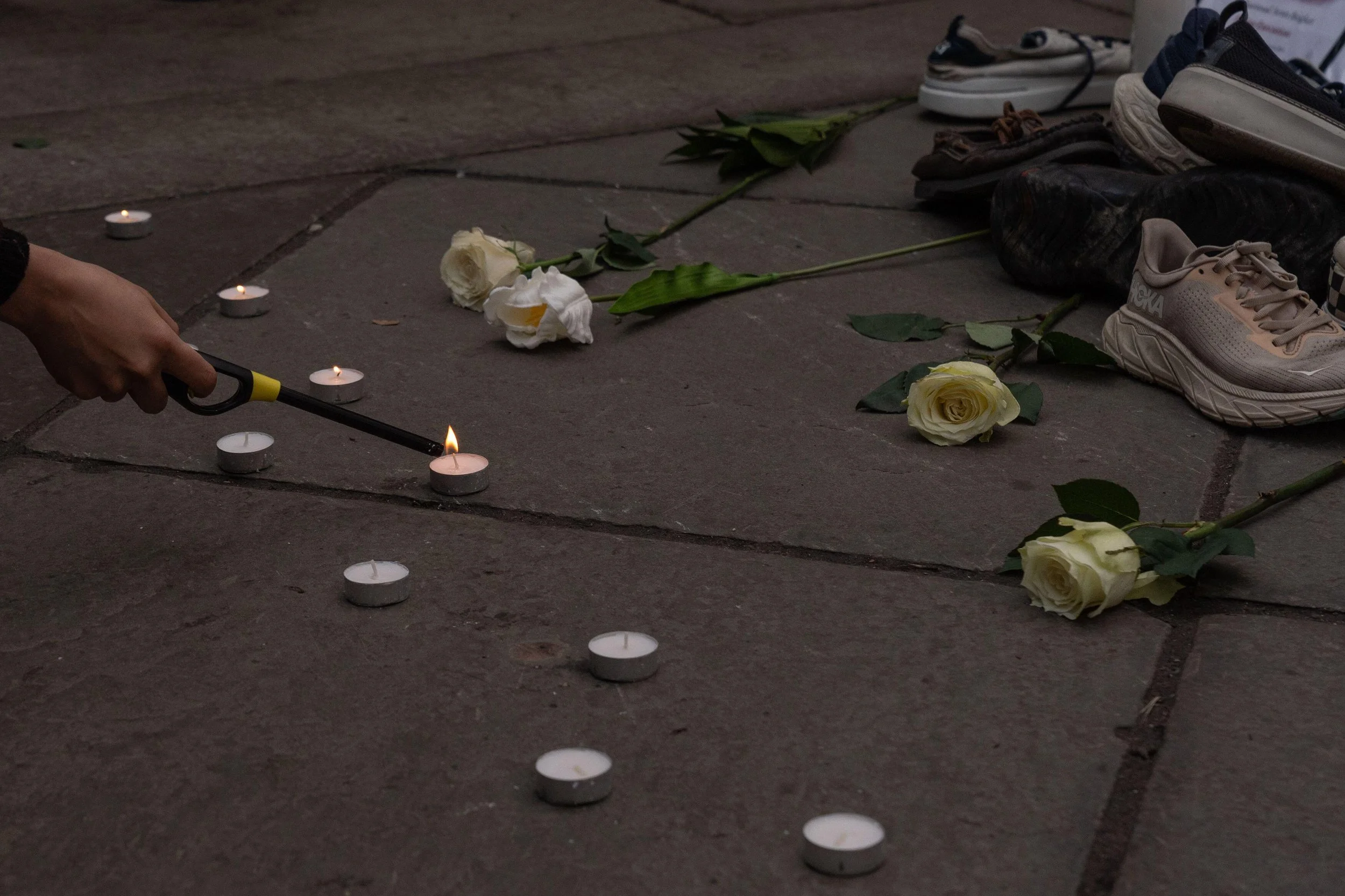
A candle is lit at a vigil in New York City honoring protesters slain in January’s uprising across Iran. February 21, 2026 - Source: Lev Radin, Alamy
We sit now on the precipice of a conflict which is in all likelihood to forever alter the face of the Middle East, in an apparent revival by the Trump Administration of much of George W. Bush’s interventionary doctrine in the region, coming from the man who jetset his way into American politics by deriding Bush and rejecting the ruling narratives in the GOP around those very policies he now privately jostles with himself. The largest concentrated buildup of US military power in the region since that which took place prior to the 2003 invasion of Iraq grows continuously each day, as the region hurriedly braces for a potentially catastrophic confrontation now decades in the making. To go so far as to initiate such a war, but stop short of regime removal, would more than likely be a waste of untold thousands of lives, billions of dollars, and perhaps scores of precious munitions, but is it something which can even be achieved through air power alone? I believe we are soon going to find out.
At the beginning of January, 2026, as most of you I would hope are already aware, the Islamic Republic of Iran undertook what is by reliable estimates the largest and most brutal state orchestrated crackdown on internal dissent in its own history, and that of the 21st century as a whole. Anywhere from an estimated 30-100,000 people were killed as the regime lashed back at what we now believe to have been the largest popular opposition demonstrations since it officially came to power in 1979, spanning millions through every city, and every province of the nation.
The protests began modestly as store owners took to the streets to voice the pains of rapid inflation, which had fallen sharply off a cliff in early December. Quickly, they ballooned into a general uprising against the regime itself, with many in the crowds heard chanting “death to Khamenei,” “death to the dictator,” “Javid Shah” (Long Live the King), “[Shah] Pahlavi will Return.” and more, going so far as spray painting these slogans in public spaces, even doing so on regime affiliated buildings and the homes of officials. Iranian women, proudly showing their idyllic beauty free of religious face coverings, could be seen lighting cigarettes with burning pictures of the ailing 86 year old theocrat, Ali Khamenei, a sight history should not soon forget. For a brief moment, it almost felt like a party, one filled with hope, unprecedented defiance and an open bar serving molotov cocktails.
In the nights leading up to January 8 and 9, violent clashes had broken out between protestors and various regime forces, many of which resulted in deaths on both sides, but it was only then that the gut wrenching industrialized slaughter of citizens began. A near total internet blackout had been in place for days when aerial surveillance drones, rooftop snipers, truck mounted heavy machine guns, assault rifles, sub-machine guns, shotguns, machetes, axes, chemical weapons and more were deployed, all tools which the Iranian security apparatus used with a “blank license to kill” in order to put down the uprising at whatever cost required. It has been reported that elements of Iraqi, and potentially Lebanese Hezbollah took part in the slaughter, as well as other groups under the Popular Mobilization Front in Iraq, and those operating in Afghanistan under the Fatemiyoun Brigade, in addition to the IRGC and Basij elements who were primarily involved.
It wasn’t until the early hours of January 12th that videos, images, and eyewitness accounts began to reach the outside world, documenting the horrors which had taken place days earlier. Never in all of my years studying war and mass murder in the modern world, have I bore witness to such physically sickening scenes, at such scale, in near real time. Even I, well versed in the general disregard of authoritarian regimes for their citizenry, naively believed that open slaughter by a state at such a scale would remain relegated to the pre-internet age of the 20th century. Bodies were delivered by 18-wheeler to morgues in the Tehran area for identification by family members. Their photos, many of faces mutilated beyond recognition, were displayed to those searching for dead loved ones in slideshows on television screens, inside something that resembled more closely an auction house of human torment. Many, likely under orders, were shot multiple times in the head in order to leave bodies unidentifiable. Families were charged what has been referred to as a “Bullet Fee,” equivalent to roughly $3,500-4,500 USD, to secure the return of bodies for burial, with forced signature of affidavits claiming they had been killed for any number of reasons besides the truth. To bury loved ones with honor, few elected against giving into the regimes demands despite the enormous financial pressure they currently face.
In the span of roughly a week, so many were killed that Iran was reportedly faced with a national run on body bags, as images could be seen of bodies stacked in piles inside overrun morgues across the country. In no uncertain terms, the regime carried out an atrocity comparable only to previous democidal slaughters of the 20th century; sounds and images which this time, will live on into eternity.
It is possible, I would say very likely, that both Donald Trump and exiled Crown Prince Reza Pahlavi, son of the late Shah, separately influenced the scale and intensity of the protests at significant scale, through Trump’s repeated threats to the regime over protestor deaths and pledges to back protestors with air power, while Pahlavi issued a number of calls to action through social media which very clearly did reach large numbers of Iranians and spurred millions more onto the streets. At one point on January 14th, an unknown number of American fighter jets were reported in a frenzy over Iraqi airspace, poised to strike, but called off by the President at the last minute.
Since then the United States has engaged in multiple rounds of indirect negotiations with the regime, most recently in Geneva last Monday, aiming to secure a moratorium on uranium enrichment and other activities related to its nuclear program, confiscation of existing highly enriched uranium within the country, limitations on the size and capabilities of its ballistic missile program and arsenal, its support for militant proxy groups throughout the region, and concessions on the regime’s very treatment of its own people. These negotiations have occurred in what is believed to be an attempt to ease worries among regional allies who have privately lobbied against a conflict, and to exhaust diplomatic channels to secure greater public credibility before the seeming inevitability of war. So far, talks have rendered little progress which has been publicly acknowledged, and the private musings of US officials and their Iranian counterparts is unsurprisingly bleak given the known stubbornness of this regime to negotiate in its now decades long record of anti-American hostility.
Multiple times in the past two months, Donald Trump has hinted at a willingness to pursue regime change in Iran. In mid January he described Khamenei as a “sick man,” saying the country needs new leadership. And just a few days ago, when he was pointedly asked if regime change is something he’d like to see, he said “Well I think that would be the best possible option,” to which he then spoke on the trauma and suffering American soldiers have faced in the region at the hands of Iran and the tentacles of its forces.
President Obama, and then Deputy National Security Advisor Ben Rhodes, along with National Security Advisor Jake Sullivan, in an effort to meet Obama’s 2008 campaign promise to withdraw US forces from Iraq, pursued policies on Iran, Iraq, and the greater Middle East for which it would be overly kind to describe as appeasement. They engaged in broadly enabling the Islamic Republic to grow, and further develop its offensive military posture, the scope, scale, and abilities of its regional proxies, specifically the PMF Shi’ite groups in Iraq which before had been at a marked disadvantage to opposing Sunni militants, but also the more well known Hamas, Lebanese Hezbollah, and the Houthis, as well as its economy, while attempting to rehabilitate its image and standing on the global stage. Individuals in the Obama White House openly articulated the long toyed with belief — dating back to the pre-revolution years in which Jimmy Carter’s entourage of new world thinkers hailed Ruhollah Khomeini as a moderate reformer right up until the day he took 52 Americans hostage — that reformist elements within the regime were capable of overcoming its clerical nature of holy violence and aggression, despite overwhelming evidence that those very “reformist” elements have repeatedly been involved in the regime’s many atrocities committed against citizens, and hold little power, or will, to do so.
In their pet project, they sought to create what was in effect a regional balance of power, an expanded Iranian sphere of influence which would act as a stabilizing force against both growing Israeli hegemony, the dominance of the Sunni Muslim Saudi Arabia and the Gulf States, and the various Sunni militia elements across the region. They gave a level of deference to Iran which would have been unthinkable under Bush, right after we fought with them tooth and nail in Iraq and Afghanistan for years prior. Obama on numerous occasions refrained from striking Shia militants in Iraq when IRGC personnel were known to be deployed amongst them. The seditious nature of Obama’s Iran policies truly cannot be understated. Cowardly, they tried to “reset” the relationship — much like Hillary Clinton’s big red reset button she laughably presented to her Russian counterpart — after they took Americans hostage, most held for over 400 days, in the honeymoon of their coming to power, after they slaughtered 241 American soldiers in the 1983 Beirut Marine Barracks bombing, again in 1996 when they bombed the Khobar Towers killing 19 airmen, when they provided training and logistical support to Al Qaeda leading up to the 9/11 WTC bombing, and continued to support and harbor key operatives in the years that followed, after they helped birth the insurgent groups in Iraq and Afghanistan who killed thousands of American soldiers and were instrumental in shaping the protracted debacle those wars became, in their steadfast support of the Taliban which has continued into and after their return to power in 2021. This list does not even touch on the aggressions they have committed towards the people of Iran, nor US allies and other nations in the region in the same span of time, or this article would be many pages longer.
At the core of his administration’s delusions, existed the flawed belief that radical Islamists, be they the rebels in Libya, or the Iranian regime itself, were capable of advancing regional peace and stability. By their very religious and ideological nature, the inverse has proven consistently, and overwhelmingly to be the case. Along with Iran, though not in cooperation, the Obama Administration lent military, intelligence and arms support to various forces of the Arab Spring, most notably in the NATO bombing campaign which resulted in the overthrow of Libyan strongman Muammar Qaddafi in 2011. The loudest critics of Western foreign policy have long since raised Libya as a primary example alongside Iraq and Afghanistan as evidence to their belief that foreign intervention is by nature a non-solution, and should be abandoned entirely as a policy tool by the United States. They importantly fail to point out that specifically in the case of Libya, the groups elevated to power were in many ways fueled by the same forms of ideology which we were at war with elsewhere, and the specific, ideological threads which connect all three.
Iran is notably different, Persian people — though not the only ethnic group who call the nation home — are the heirs of an ancient civilization, culture, language, and heritage, which far predates the founding of Islam. Even under the specter of ideological repression, after decades of rampant inflation and economic suffering, their rich, strong nature remains. They are an educated, intelligent, industrious, entrepreneurial, friendly, and principally peaceful people, who have in these wilderness years formed thriving communities in the United States and Europe from which we have benefited greatly. For nearly five millenia the land now called Iran was governed effectively by monarchy, and there still exists within the country an institutional memory of what life was like prior to the revolution. Before Khomenei, Iran was a stable, rapidly advancing, secular nation, and a staunch US and Western ally under progressive governance, certainly by regional standards. “What was once a source of leadership, and stability in that part of the world,” to quote President Nixon’s remarks on the tarmac in Cairo as he arrived to attend the late Shah’s funeral in 1980. The great paradox of the last Shah, Mohammad Reza Pahlavi, is that in liberating various groups, in particular women, and in sending much of a generation of young Iranians to study abroad in prestigious Western universities, the very people whom he sought to uplift returned from overseas, drunk on the toxic sludge which infests American academic institutions, quite bluntly to overthrow his government, and succeeded in doing so. A phenomenon which bears some unspeakable parallels to the West itself now.
Having lived 47 years under the misery the revolutionary regime created, the Iranians of today, the youth in particular, are fed up to the point they are freely willing to throw their lives behind change as has now so tragically been seen. They have been all too well versed in the vile, regressive evils of political Islam, and many have since rejected religion outright.
Let it be clear, in as much as this regime has been a sworn enemy to its own citizenry for all 47 of those long years, they have been openly at war with the United States. They spread violence and instability to all corners of the world based purely on ideological grounds, choosing rather than to enrich its people, to rob them of their well being, and their future in order to fund bloodshed and blanket aggression. For its indirect involvement in 9/11, and the insurgencies targeting American forces in Iraq and Afghanistan, Iran falls squarely within the post-9/11 Congressional Authorization for Use of Military Force, and Donald Trump would be acting well within legal limits to initiate operations absent a new AUMF, as much as it would regardless be preferable for him to present his case to Congress. More, I would argue that a hot war with Iran additionally falls well within the bounds of Just War Theory, and is prudent, justified, and necessary not only in the interest of improving the living conditions of Iranians themselves, but for the stability of the region, and the balance of power on the global stage as a whole. In particular given the recent, very open cozying of relations between Iran and Western adversaries, namely Russia and China, and the military and technological transfers which have occurred since.
As regime change sits on the table as a likely aim for this coming confrontation, many will point to Iraq (2003), Afghanistan, and Libya as proof that the model of US intervention, with the specific aim of toppling and replacing governments, is inherently flawed, destructive to regional stability, and is something that should never be tried again. Donald Trump of course rose to early prominence in 2016 for his comments on the GOP primary debate stage denouncing US policies in the Middle East. To the great displeasure of the American media bench, the ever growing slew of podcasters, online ideologues and armchair foreign policy experts, and most Americans, regime change has been, and remains a part of the wide ranging toolset available to Presidents in executing foreign policy.
I am a pragmatist, and a realist, and by no means a doctrinal interventionist, but in the face of this regime, which is inarguably doctrinal in its governing ideology, I believe the military option is the only one with any chance of success, and to abandon it, would only serve to push an inevitable conflict down the road, where we could well be faced with a stronger enemy and a weaker president. In the aftermath of last June’s 12 Day War between Israel and Iran, US strikes on Iranian nuclear facilities, and the greater proxy war waged since the events of October 7th, it has been shown that despite very real retaliatory capabilities they possess in long range ballistic missiles, the fangs of its vast proxy network have proven a hollow threat, systematically degraded over the past two and a half years. Their air defenses were all but annihilated by Israel before and during the war, as was much of their ballistic missile arsenal, and the IAF showed a remarkable ability to locate and strike a slew of targets, including nuclear scientists and high level leadership figures deep inside enemy territory with only modest risk to their own aircraft.
There are a few fundamental questions which have not been publicly answered. Popular opposition, and whether or not there is an organized force capable of filling a vacuum, including the potential for breakaway elements potentially within the IRGC, Basij, and the regulars military who would turn on the regime and train their guns against them. We’ve already seen reports that there were regime security figures who refused orders to kill in the protests, for which at least some of them were executed. It should be noted, that any regime whose only means of retaining control exists in mass violence not only against the populace, but those who serve it, has lost any shred of legitimacy it once had in governing. I cannot speak with credibility on either of these subjects, and the only people who can are those who are there themselves, and individuals with high level security clearances, but given the level to which we have seen Iran to be penetrated by US and Israeli intelligence services, if either exist at scale, confirmative intelligence surely exists accordingly.
Then there is the greatest question, of who would lead a transition government, and what such a thing would look like. It is apparent that the only individual with any capability of doing so is indeed Reza Pahlavi, despite not having set foot in the country since the revolution. As he has I believe correctly argued, the regime security apparatus has been so utterly effective in crushing internal opposition, that successful resistance at an organizational level has been nigh on impossible, let alone the elevation of leadership figures, as near all who have tried have been imprisoned and executed. There has been much speculation since the outbreak of the uprising as to the true extent to which he enjoys popular support in the country, something we are unable to firmly determine from the outside. A general consensus has for some time existed in Western foreign policy circles that while he is beloved by the diaspora, his support inside the country may be deceptively small, something he and many others today would contest. What is now known, is that a great many people surrendered their lives to gunfire in chanting his name, and for the explicit return of the Pahlavi Dynasty to Iran, and if that is not a moral mandate to lead, I do not know what is. He and his organization, along with the US based, Pahlavi sympathetic NUFDI, the National Union for a Free and Democratic Iran, have proliferated plans released last summer for a transition government in the form of a temporary absolute monarchy with him ruling as King, with the intention of holding a popular referendum on a permanent system of governance, whether that be a constitutional monarchy, an open democracy, or the continuation of absolute monarchy, with definitive proposals for the limited disillusion, and reform of various regime entities to attempt a smooth, progressive transition unlike that which occurred in Iraq. Principally, he has argued for the regulars military to be preserved to whatever extent is possible in the event of a war, so as not to repeat the disaster of our disbanding the Iraqi army after the fall of Saddam Hussein, and for Iran to retain basic military capabilities in the event the regime were to fall. He has said firmly, most recently at the Munich Security Conference, that those in the regime today who are without the blood of Iranians on their hands, are deserving in the opportunity to participate in the formation of a new government.
This coming war of course differs fundamentally from previous regime change endeavors — though Libya, and perhaps the 1998 air campaign against Iraq draw some parallels, though it was not a regime change operation — in that Trump desires a quick, and decisive result through US air and naval power, perhaps paired with limited special forces raids, though our ability to safely insert and extract forces deep in country remains to be seen. What is clear, is that no large scale American ground force will be pushing into Iran, not under current circumstances at least, and that there is a belief the campaign’s goals can be met within a number of weeks, the possibility of which again remains to be seen. Uncertainty doubtlessly abounds inside the Pentagon and the White House, but the scale of both offensive and defensive equipment now amassed is undeniable, and grows daily. I do not doubt the US military’s ability to destroy any target which it is directed to with limited risk to those involved, and the daring early January raid on Caracas which extracted Nicolas Maduro should indicate that our armed forces have entered a new era of readiness and confidence, after well over a decade of disorder and exhaustion following the prolonged failures of Iraq and Afghanistan. As Defense Secretary Pete Hegseth has repeatedly stressed, this is a military which is firmly committed to asserting, and maintaining deterrence anywhere in the world, and that flagrant defiance of Trump’s threats over the protests will be no exception.
And so, we now find ourselves in a position with only one presumable end. The Administration has not backed down from its threats, while continuing to build a menacing force posture with apparent intent to use it, and regime officials have given little ground in negotiations which will prove in all likelihood, as in the past, to be fanciful. The Islamic Regime is now well evidenced to be weaker than at any point since its inception, largely due to recent military setbacks, and the success of maximum pressure sanctions policies applied intermittently by the United States over the past decade. For most of that time, and before, regime change has been our policy position toward Iran, and the measures which sought to induce it, have now clearly reached their logical conclusion. The opportunity Trump has spent much of his political career working towards, is now sitting in front of him on a silver [or gold] platter, and will not remain hot for long. So what exactly are we waiting for? The blood worshipping, zealotrous bastards Khamenei commands are not going to bomb themselves.
